
Table of Contents
I’ve been teaching since 2001, and have a special place in my heart for teenagers. They’re right at the intersection of obnoxious and intelligent and, okay, maybe I relate a bit to their angst. A friend of mine asked if I might be interested in teaching a visual storytelling course for displaced teens living in Jakarta, Indonesia.
So far I’ve worked with teens in the US, Korea, Indonesia, and China in diverse settings. My friend told me about the work he was doing with Roshan Learning Center, a program serving asylum-seekers and refugees living in Jakarta.
Roshan runs their learning center with the help of donors and an unpaid community of volunteers. They note that many of their most motivated students are living in Jakarta without a family — and they step in as a surrogate.
Check out Roshan’s website if you want to learn more about their mission. Roshan runs on donations and if you’d like to be part of the good work they’re doing, consider a secure online donation (available on their site). They are doing important work and I can testify that your donation will be put to good use.
Brainstorming a meaningful visual storytelling course
When my friend asked if I’d like to get involved, it was perfect timing since I had just quit my job in Korea, and moved back to Indonesia.
I started thinking about a class that tied together visual literacy with micro-storytelling, a visual storytelling course. I wanted self-expression to be an integral part of the class curriculum. From experience working with other vulnerable populations such as kids in foster care, incarcerated, and homeless teens, I’ve learned how meaningful creative expression can be.

Storytelling can serve a crucial role for young displaced people. They have been affected by unrest, forced to move repeatedly, and now live in limbo, Creative expression gives them tools for sharing their lives as well as starting to confront, in a gentle way, some of the things they have encountered.
I discussed how I would approach the curriculum with the friend who told me about Roshan. We talked about how important it is for millennials and Generation Z to be able to articulate their story.
And how being displaced adds another level of nuance. Do you ever get your needs met if you can’t tell a compelling story about your life, or convince someone to put their faith in you by giving you a job or home?
My students at Roshan would be teens, and some were unaccompanied minors. Some had been in Jakarta for years and spoke Indonesian well, others were newly arrived. Although most were from Afghanistan and Iran, there were students from other countries as well.
Microstorytelling on Instagram Stories
After speaking with Roshan’s staff and getting information about the students’ interests, we agreed that I would teach a 6-week visual storytelling course, focusing on micro-storytelling. Next, we had to decide what medium we’d use to teach the storytelling course.
Logistically, it made sense to focus on a project we could do with cell phones. Next, we thought about where the students were hanging out online. The overwhelming majority seemed to be on Instagram. So we decided the class would focus on Instagram Stories as a medium.


Above, you’ll see some of the views from the train ride to Jakarta
Time to teach the microstorytelling classes
We took the train from Yogyakarta to Jakarta each week for classes. It was a very long trip and hard on our bodies. These are views from the train and the train station. And, here is a video of what getting off in Senin Station in Jakarta is like:
What are Instagram Stories?
Instagram Stories are mini-stories that you can share with your followers. Instagram offers different features for these stories, including video snippets and photos to share to your Instagram Stories. To make them interactive, you can customize them with text, polls, GIFs, questions, etc., to get your audience involved.
In our visual storytelling course, we talked about the basics of an Instagram Story, and how to use the different features. Most of the students were familiar with Stories. But they had to wrap their heads around creating engaging stories, and not just unrelated clips, which takes intention and planning.
Micro-storytelling and telling short form stories
Our class explored micro-storytelling and how to create a compelling story in minimal time. Micro-storytelling requires many of the same skills as longer-form storytelling. But Instagram Stories are fun because they disappear.
If you like what you’ve made, you can keep your stories in the Highlight Roll of your Instagram account indefinitely. But if they aren’t that memorable, you can let them fade into oblivion after 24 hours. Sort of like a modern version of a temple sand mandala.

Instagram stories and micro-storytelling cater to current times. We are inundated with content, and only have the time to watch, read, consider, or interact briefly.
Quickly digestible doesn’t mean simple, though. So, creating engaging stories using micro-storytelling is an interesting and timely challenge.
Getting to know my students
A few weeks into my class, one of my students was resettled in Phoenix, Arizona, my old stomping ground. Although I missed having him in our classroom because he was smart and engaged, my happiness that he had some certainty in his life far outweighed that.
As the weeks went on, I enjoyed getting to know my students better. Their experiences of Indonesia were very different from mine. First, I have my white privilege, which colors every interaction here. First, I have my white privilege, which colors every interaction here. Only some of my students enjoyed this experience because of their skin color.
Then there’s the daunting nature of Jakarta itself.


Jakarta is a trip
Each week I taught the class, I walked from the busway to the small street where their school was located. I passed broken-down buildings, small warung (neighborhood shops), a mosque, a series of tiny alleys through which people rode their motorcycles brazenly, a family raising cows in the middle of the city right next to the river, which smelled like…well, you can guess.
This was a teeming reminder of how many people (and cows) are around you at all times. And just how overwhelming the city can be.
One of my favorite activities in Jakarta is counting rats. (In case you were wondering, I don’t discriminate between those who are alive or dead. On one of my brief trips to the city to teach the class I encountered 7.)
Mix in the constant onslaught of motorcycle traffic and the unceasing reek of sewage, and you’ll start to get a sense of the assault on the senses that is Jakarta.
If you’ve only been to Jakarta…
I discovered that some of my students had never tried most of Indonesia’s tropical fruits, or ever visited another island. So, of course, their perceptions of “Indonesia” were skewed by their reality.
However, despite the intensity of Jakarta, some of my students loved Indonesia and wished for nothing more than to settle here. Unfortunately, there is currently no way for them to do so. So, they remain in limbo, not able to work, attend public school, or leave.

While I taught the class, my husband created a mural for the wall in Roshan’s preschool area. A couple students, as well as a teacher, helped out. It was fun to watch the mural come to life as the weeks went by!
I offer customizable photography and visual storytelling courses
Since 2001, I have taught children, teens, and adults in diverse settings, such as private and public schools, universities, prisons, and community programs. I help students uncover their vulnerability so they can lead more intentional and fulfilling lives.
As I usually do, I learned a lot from the Roshan students. I had assumed that they would be very social-media savvy, and they were. But, I was still able to help them learn some useful photography basics, about how to create well-composed images and how to use search and use hashtags.
The culmination of our visual storytelling class
Not surprisingly, it took practice for my students to understand how to create a compelling and well-rounded story. Six weeks was barely enough time for this group. I have kept in touch on social media, however, and occasionally give them feedback about their stories or photographs.
In our last class, we had a viewing party. I brought lots of different fruit to eat as we watched their group Instagram Story projects. Some groups put a lot of time and effort into their final projects. We offered small critiques and lots of applause. Mostly, my wish is that they keep building on the skills they learned in my class in order to become even more savvy communicators.
Improvements to the class
The next time I teach this class, I’d like to create even more chances for group work because it seemed to make it easier for the students to finish their homework. I also noticed that working in groups helped the students become more confident storytellers.
I loved teaching this course. Offering students the space to learn how to powerfully share their own narratives can help them with finding housing, and employment, not to mention how storytelling nourishes the soul, and offers a clearer understanding of past experiences and the self.
What is my teaching philosophy for these visual storytelling courses?
My philosophy is founded on the research of Brené Brown, who studies courage, vulnerability, shame and empathy. She says that although we may experience pain and other difficult emotions when we are vulnerable, owning our story and expressing vulnerability expands our potential to create more meaningful relationships.
Using these ideas to create better photography involves making deep connections with the people we photograph. And in order to relate to our audience, we must be truthful about our feelings. In the Roshan class, we took photos of each other and the dynamic began to change from restrained strangers to friends.


Creating relationships makes for better photos
I take a hands-on approach with both my students and the people I photograph. When I open myself up to them, they do the same for me. But it’s a process that calls for sensitivity. Being vulnerable does not mean oversharing or making people open up when they’re not ready to.
I believe that If you can find the balance and cultivate this mutual bond it will help you create more truthful photographs that better capture the essence of the people you photograph.
In my courses, I convey this philosophy and work with students to discover how they can create their own distinctive approach while connecting with their subjects.

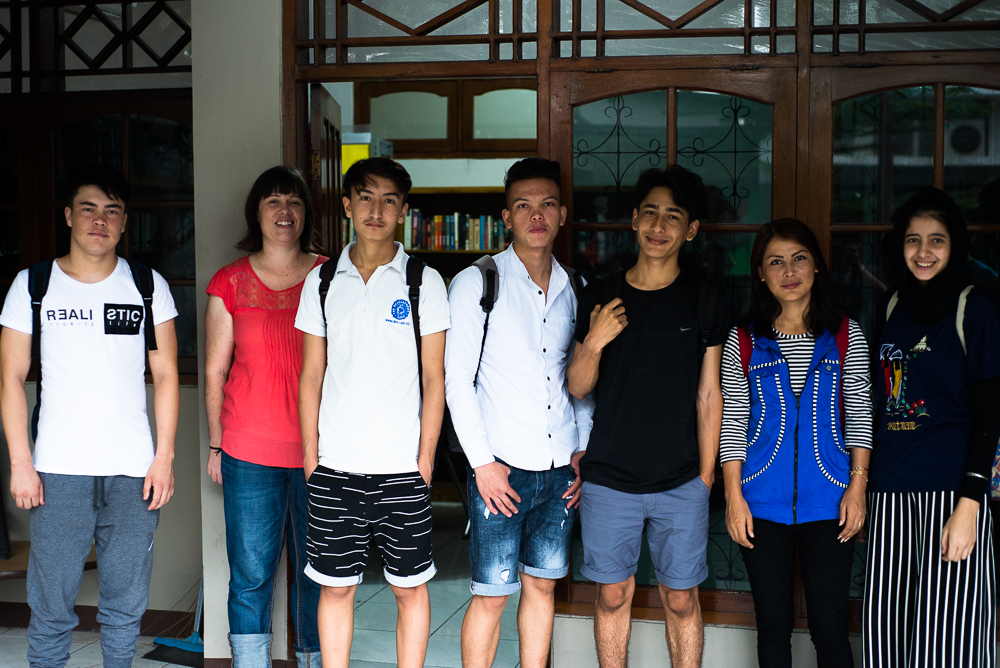
Some of my visual storytelling students pose for a photo
Interested in learning more about visual storytelling courses for social media or strengthening your photography skills?
Are you considering hiring me to teach a visual storytelling course for your community? I can curate course content on a wide variety of topics Let’s explore the possibilities.
To learn more about what type of material I could share with your community, please contact me.

A note about the images. Most of the photos were taken with my cell phone, and also I got permission to use each photo of my refugee students in this article.

2 Responses
rosegerstner@gmaii.com
Interesting work! Found the improvised ladder very funny!
Yes, I’ve seen many of them in Indonesia over the years! Ha!