
Table of Contents
Artist Matthew Revert and his endearing weirdness
Matthew Revert is a writer, musician, visual artist and graphic designer from Melbourne, Australia. He says he lacks time for anything else and I have no choice but to believe him. Although Matthew’s work falls into different spheres he feels it all is inextricably linked, although rarely are the links intentional.
He is talented and prolific and lucky for us, many of his projects are being realized this year. Below, he speaks about the relationship between hard work and creativity. Enjoy this interview!
When did you first discover that you were a creative being? What were you doing?
This question poses difficulty for me because I believe we all create from our earliest moments. One could say each of us creates the world in our effort to understand and become a part of it. However, were I to pinpoint some moments that suggested a creative bent, I would highlight the following. One of the earliest birthday presents I recall was a blackboard from my parents. I spent so much of my youngest years at that blackboard, chalk in hand, drawing and erasing, drawing and erasing.
I remember the reverse of the blackboard was comprised of different material, which didn’t give up chalk easily, so this side slowly became a densely layered series of ghosts. Another gift I will mention briefly was a toy drum kit I was given when I was three. I was fascinated with how I could use this kit to derive sounds beyond what was expected.
How do you express your creativity? How did you first become interested in your creative practices?
I believe the act of my existence is an expression of my creativity inasmuch as who I am and what I create exists in an often-uncomfortable symbiosis. This, to me, feels right.
Creativity is a gift we are given designed to help us navigate our lives and derive meaning. Interest in my creative practices came in waves.
Illustration was my first love, which was followed by film, music and then writing. Most people assume my musical practice is a comparatively new development because it only gained recognition after I had several books published and my reputation as a writer had been confirmed. The truth is, I was producing music over ten years before I ever wrote my first story. It just so happens the music in question was not very good and rightfully ignored.
You have many creative pursuits in different spheres. Do you think they relate to each other somehow? And is there some new media or approach you’ve been wanting to try?
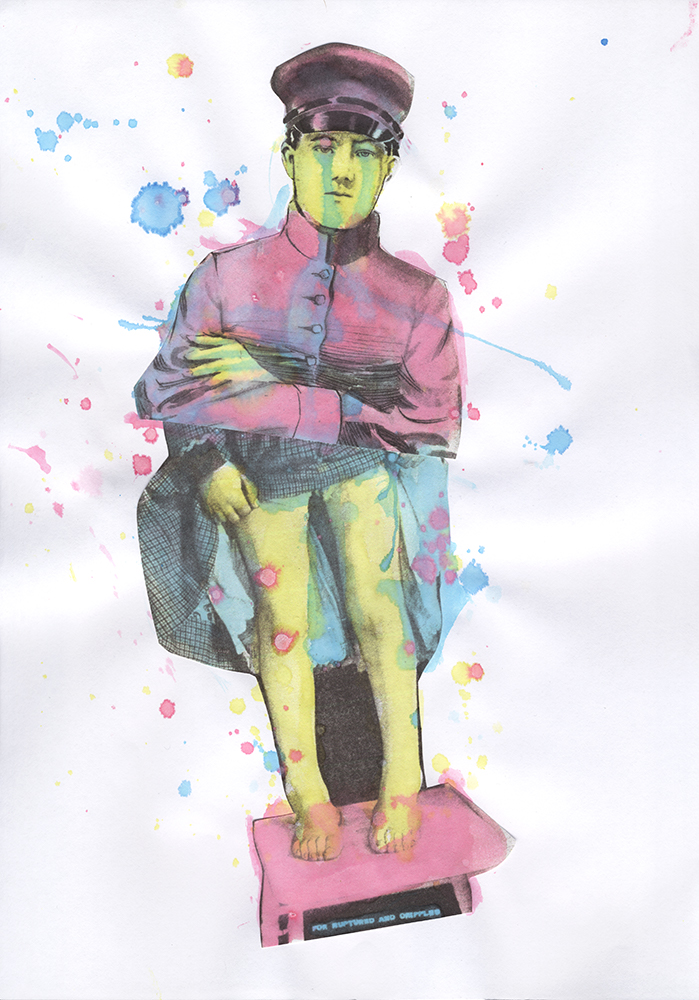
To me, each of my creative pursuits in different spheres are inextricably linked, but rarely is that link intentional. Like the watercolours in my visual art, they bleed well beyond the defined lines and most of this bleeding occurs outside of my ability to control it. This tendency is one of the most personally rewarding aspects of all creative pursuits. The unintended become their own intention and teach you about your own work.
Regarding new media I wish to explore, I would love to work more with video and animation. I have started to experiment with it and I am very lucky to have a record label in Australia releasing some of this video/animation work soon, but I long to explore it more and perhaps start making films. Time and money will be the key.


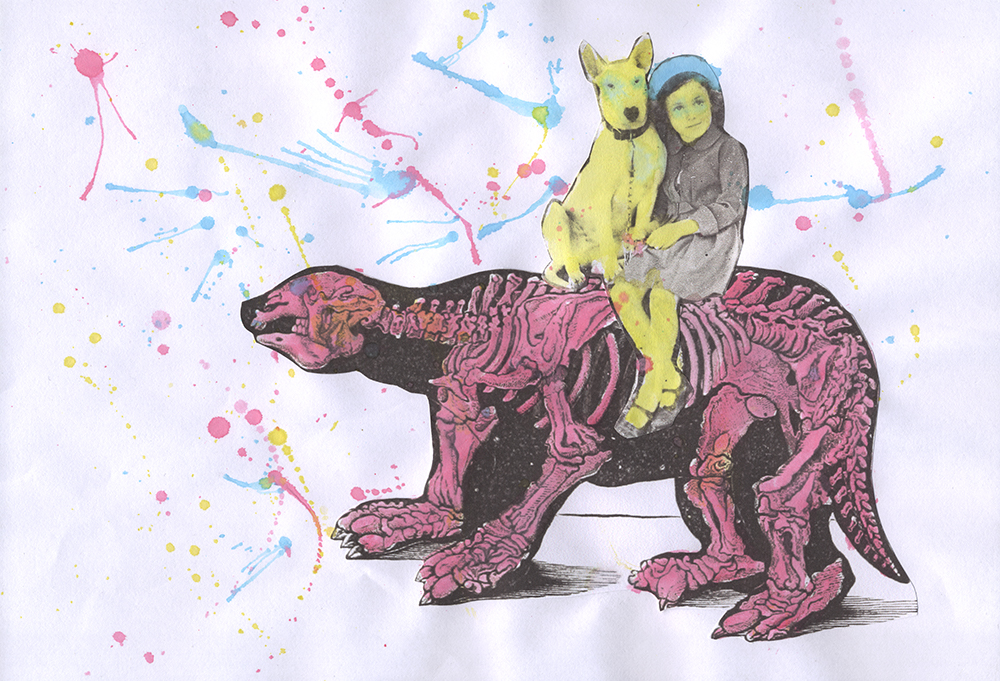
I’m especially drawn to your colorful and sometimes sardonic pieces which appear to be line-drawings with collage, and seem to begin with photographs or newspaper clippings. Could you talk a bit about the process of creating this work?
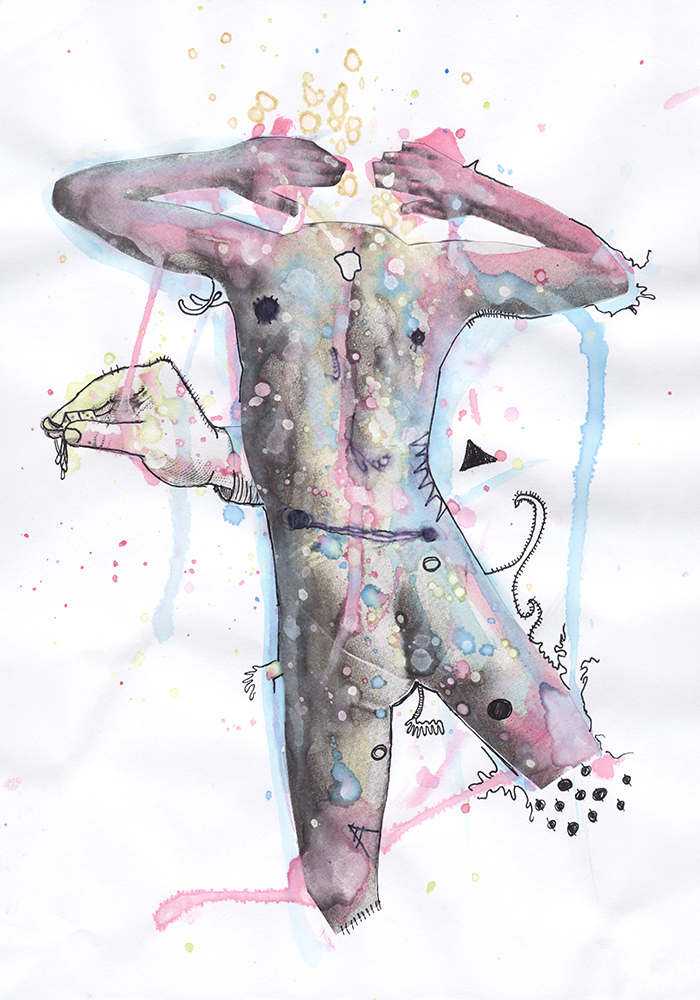
The current visual art pieces that I am producing possess a very deliberate intention that (I hope) bind them together. One aspect of creative pursuit in any medium that I have always found distasteful is the emphasis on using the best, most expensive tools. If an artist wishes to focus so heavily on this component, that is their choice, but I wanted to steer very clear from it. My desire was to create art in the cheapest way possible – one that defied the archival process. I used the cheapest tools I could.
All collage elements are produced on a cheap inkjet printer using standard document paper. All painting comes courtesy of a $5 Crayola watercolour set I purchased from a department store (with brush included). Anything else is standard pens and markers. I have found ignoring the temptation to use quality materials to be so freeing. Limitations I do not expect present themselves and new opportunities emerge because of this. I may never have thought of these possibilities otherwise. There is a great deal of immediacy and excitement within me when I create visual art now and I believe this method is a big reason why.
Is there a specific formula or setting that allows for your creativity to flow? Any rituals you must perform? What’s your work process like? Describe a day in the life of Matthew Revert.
Creative individuals who only create when possessed by some divine spark of inspiration bother me. Why would you give up so much of your autonomy to this spurious outside force? My formula for allowing creativity to flow is discipline. I work and I work and when I don’t feel like it, I still work and work. I wasn’t always like this, but it wasn’t until I introduced discipline into my creative life that I started to feel my work had merit. So a day in my life would likely be extremely boring for any outside observer. I just work – nothing more to it. I’m just very lucky that I love doing most of the work I do.


Do you often have multiple projects going on at the same time and, if so, do you find it overwhelming?
The nature of working in different mediums often results in multiple commitments I must meet at the same time. This can become overwhelming from time to time, but usually, I find it exhilarating. I am able to direct my focus to whichever project I feel the most immediacy toward. As a result, I am usually able to maintain a sense of energy and momentum. It’s a little different with my graphic design work because that is more like a typical ‘job’. I have clients and these clients have deadlines and expectations they expect me to meet. When several of these jobs have deadlines and expectations that converge, it can get a little tricky.
What challenges have you faced in your creative practice?
When most people first send their creative pursuits out into the world, it is typical (and understandable) that they desire to have these pursuits acknowledged by the world they just sent it into. The reality is that most of us will have our work ignored for a very long time – sometimes forever.
When I first started, I definitely wrestled with this. I wanted the work I put in to be reciprocated but the truth is the world owes me nothing. The challenge I faced (and that many face) is learning to stop caring. If you were to put a book into the world that no one ever reads, you need to be ok with that. Learn to be ignored. Learn to thrive while being ignored. If you can do this, you will keep working and if you keep working, you keep giving your work a chance to get noticed. Many people give up during the ‘ignored’ stage and I refused to be one of those people.
I would never claim to have found a great level of success, but I seem to do better each year and am overwhelmed by the opportunities I am now given.
What do you find fulfilling about creating art? And do you expect your art to pay the bills?
I don’t want to get grandiose with my answer to this question because often, the act of creating art is spun into pompous verbiage that starts to overshadow the art. I like to always keep a foot firmly in the pragmatic side of creating art because no matter how much one waxes lyrical, it’s the pragmatic work that produces the art. What I will say is this… of all the things I have endeavoured to do in my life, art is the one that feels the most vital and rewarding.
I would never expect my art to pay the bills, nor would I write off the possibility (especially if I keep my bills low). I still maintain that steadfast belief that the more work I put in, the more I will ultimately get back.


Does society support your creative work? How about your friends and family?
Society has no obligation to support anything I do. I think a more telling question would be ‘does my creative work support society?’. One would assume, if we are driven to give the world our creative work, it’s because we have something to convey to that world. Maybe what we have to convey will resonate with someone within society enough to alter their interaction with it in a way that helps them grow. If anything I have done has ever achieved this, then I am very lucky.
My family has never stopped me from pursuing what I do, which I will never stop being grateful for. Via their own admission, they do not understand most of what I do, but this has never caused them to intervene. I keep my friendship circle very small and am so lucky to have friends who give me astonishing levels of support.
What are the three things that have helped you grow as an artist the most?
- Thriving while being ignored
- Finding excitement in my failures
- Working, especially when I don’t want to


Bio:
Matthew Revert is a writer, musician, and designer from Melbourne, Australia.
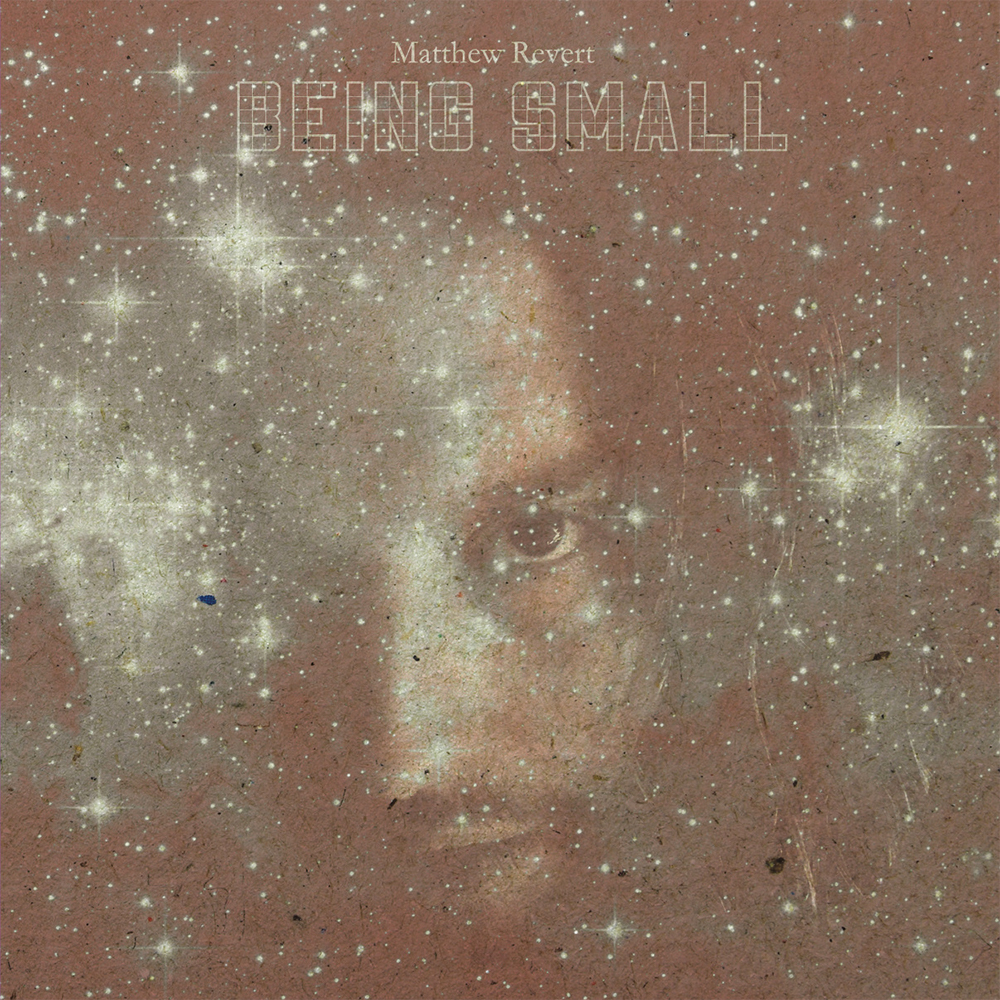
He’s published 5 books, creating the cover art for each project to boot. Aside from his conceiving the covers for his own titles, he has gained prominence in the independent press and record label world for his eclectic designs.
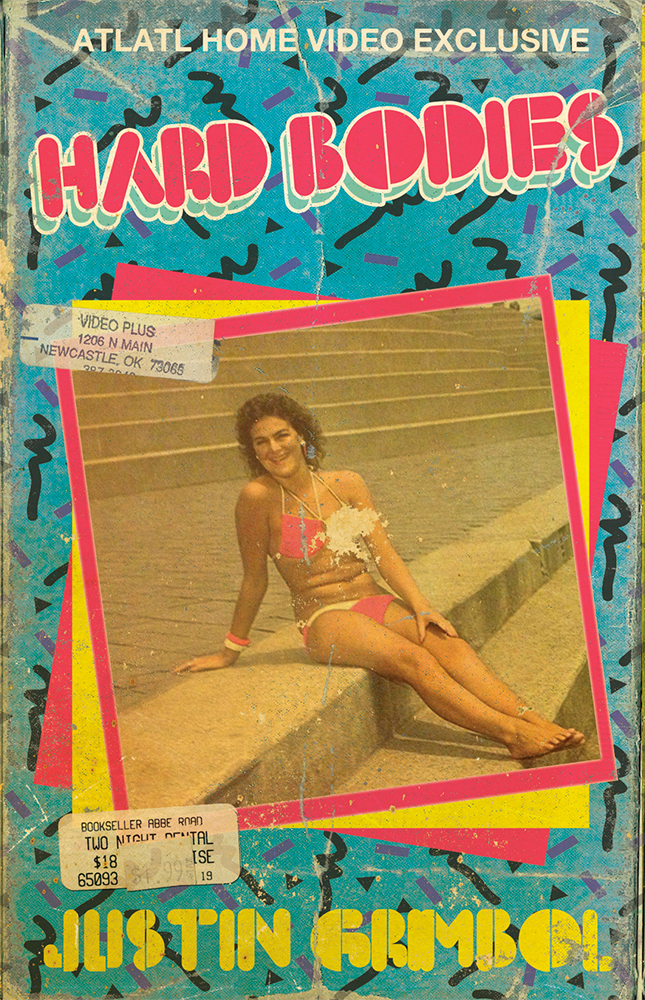
Sought for his unique style of design which often throws back to 60s and 70s era Penguin books, Matthew’s work evokes a sense of nostalgia and harkens back to an untainted version of design. Known for a wide range of design styles and implementations, possibly his most popular signature is creating distressed, aged looks which can have even the trained eye believing the item in question to be well-thumbed and roughly treated by human hands and the inescapable ravages of time.
Matthew uses the cheapest materials possible when creating collage, emphasizing the importance of process by any means necessary.
His work ranges from purely digital design, to organic construction, to creation by hand and/or a careful symbiosis of multiple mediums to create eye-catching and idiosyncratic designs.
2019 is shaping up to be busy for Matthew. Clash Books has published Matthew’s collection of visual art, TRY NOT TO THINK BAD THOUGHTS. and King Shot Press will release a book of his graphic design work from the past 10 years. Index Clean will release a DVD+CD set of an audio-visual piece he created and Erstwhile Records is launching an imprint called RevErst with Matthew’s work.
Be first to know about his projects by checking his website, or following him on Twitter for maximum enjoyment.

Hey, you, want to learn more about creating photo stories?
Learn to create a compelling photo story in only one week by signing up for my FREE email course.
You’ll learn to choose a good story idea, create a clear narrative, and put together a compelling photo story.
The best part is after the week, you’ll have a finished body of work to submit to an exhibit, share on social media, or print for your walls. Sign up here.
Recent interviews in the Q&A: Creatives Speak series:
Interview with author of New Erotica For Feminists, Caitlin Kunkel